

Quick answer: Endpoint provides protection. EDR adds endpoint visibility. XDR adds cross-system context. MDR adds 24×7 expert-led security operations. |
Which Version Should Your Business Choose?
Many organisations believe EDR, XDR, and MDR provide better antivirus protection. In reality, all Sophos tiers use the same core endpoint protection technologies, including next-generation antivirus (NGAV), anti-ransomware, exploit prevention, web protection, and device control. The primary difference lies in visibility, investigation capabilities, threat hunting, integration, and incident response.
If you are evaluating Sophos Endpoint, EDR, XDR, or MDR, the right choice depends on:
- Industry and type of business
- Regulatory and compliance requirements
- 24/7 monitoring, threat hunting and forensic investigation requirements
- Internal IT and cybersecurity resources
- Security maturity and budget
The Four Levels of Endpoint Security Maturity
As cyber threats become increasingly sophisticated, organisations typically progress through four levels: Protection, Visibility, Context, and Operations.
| Security maturity | Endpoint | EDR | XDR | MDR |
|---|---|---|---|---|
| Prevent threats | Yes | Yes | Yes | Yes |
| Detect threats | Limited | Yes | Yes | Yes |
| Investigate threats | No | Yes | Yes | Yes |
| Correlate across systems | No | No | Yes | Yes |
| 24/7 monitoring | No | No | No | Yes |
| Expert response | No | No | No | Yes |
| Security outcome | Protection | Visibility | Context | Operations |
1. Protection
Security question: Can I stop malware and ransomware?
Protection is the foundation of endpoint security. It focuses on preventing threats through next-generation antivirus, anti-ransomware, exploit prevention, web filtering, and device control.
Goal: Block known and unknown threats before they impact users or systems.
Sophos Endpoint = Protection
2. Visibility
Security question: What happened on the endpoint?
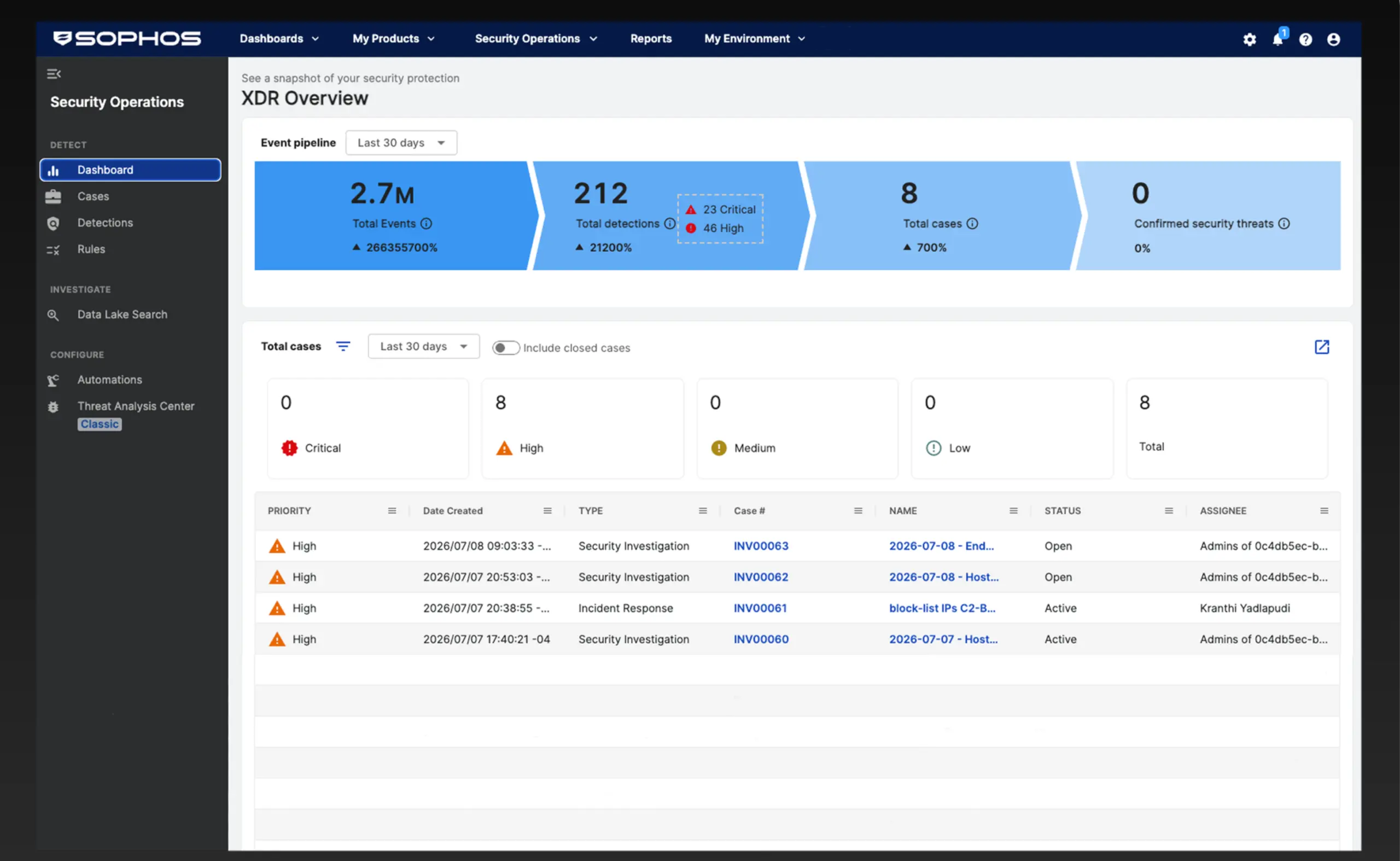
When prevention is not enough, organisations require visibility into suspicious activity. This includes detecting unusual behaviour, investigating incidents, performing threat hunting, and understanding attack timelines.
Goal: Identify and investigate potential security incidents.
Sophos EDR = Visibility
3. Context
Security question: How did the attack spread across the environment?
Modern cyberattacks often involve endpoints, email, Microsoft 365, cloud services, identities, and network infrastructure. Context enables security teams to correlate events across multiple layers and understand the full attack path.
Goal: Connect the dots and understand the complete attack story.
Sophos XDR = Context
4. Operations
Security question: Who is monitoring and responding to threats?
Technology alone cannot stop every attack. Organisations require continuous monitoring, threat hunting, incident investigation, and response by experienced security professionals.
Goal: Ensure threats are detected and acted upon 24/7.
Sophos MDR = Operations
Which Security Question Are You Trying to Answer?
Before selecting a licence, ask the following questions:
| Security question | Endpoint | EDR | XDR | MDR |
|---|---|---|---|---|
| Can I prevent malware and ransomware? | Yes | Yes | Yes | Yes |
| Can I detect suspicious behaviour? | No | Yes | Yes | Yes |
| Can I investigate an attack? | No | Yes | Yes | Yes |
| Can I determine who, what, when and how? | No | Yes | Yes | Yes |
| Can I search for threats across endpoints? | No | Yes | Yes | Yes |
| Can I correlate firewall, Microsoft 365, email and identity events? | No | No | Yes | Yes |
| Can I see the complete attack path? | No | Limited | Yes | Yes |
| Is someone monitoring alerts 24/7? | No | No | No | Yes |
| Is someone actively hunting threats? | No | Internal team | Internal team | Yes |
| Is someone performing incident response on my behalf? | No | No | No | Yes |
Industry Recommendations
| Industry | Recommended edition | Why |
|---|---|---|
| Small retail and trading | Endpoint | Basic malware and ransomware protection |
| Accounting firms | EDR | Financial data and investigation requirements |
| Law firms | EDR or MDR | Sensitive client and legal information |
| Healthcare clinics | MDR | Patient data and regulatory compliance |
| Hospitals | MDR | 24/7 monitoring and incident response |
| Financial institutions | MDR | MAS TRM and higher cybersecurity expectations |
| Insurance | MDR | High-value customer and financial data |
| Manufacturing | XDR or MDR | Operational technology and ransomware risks |
| Education | EDR | Improved visibility with manageable costs |
| Non-profit organisations | Endpoint or EDR | Based on risk, budget, donor and governance requirements |
Our Final Recommendation
- Choose Sophos Endpoint if your primary objective is malware and ransomware protection.
- Choose Sophos EDR if you need endpoint visibility, threat hunting, and forensic investigation.
- Choose Sophos XDR if you need visibility across endpoints, Microsoft 365, firewalls, email, cloud, and identity platforms.
- Choose Sophos MDR if you require security experts to monitor, investigate, and respond to threats 24/7.
The real question is not which product has the most features. It is: “What security problem am I trying to solve?”
Top 5 Endpoint Security FAQs
Endpoint security protects desktops, laptops, servers, and other managed devices from malware, ransomware, exploits, malicious websites, and unauthorised activity. Modern platforms also provide centralised policy management and security reporting.
Antivirus focuses primarily on preventing malicious files and known attack techniques. EDR adds telemetry, behavioural detection, threat hunting, forensic investigation, and response capabilities for suspicious activity.
No. The required level should match the organisation’s risk, data sensitivity, operating model, and response capability. Basic endpoint protection may suit lower-risk environments, while organisations requiring investigation or cross-system correlation should consider EDR or XDR.
XDR is a technology platform that correlates security activity across endpoints and other integrated systems. MDR is a managed service in which cybersecurity specialists monitor, investigate, hunt, and respond using security technologies such as XDR.
Endpoint protection is essential, but it should be supported by secure configuration, multifactor authentication, patching, user awareness, protected backups, network controls, monitoring, and a tested incident response plan.

Brina Teo is a cybersecurity practitioner specializing in Security Information and Event Management (SIEM), endpoint security, and Microsoft 365 security assessments. Her expertise includes Wazuh SIEM deployment, security monitoring, threat detection, incident investigation, and Sophos Endpoint Security administration. Brina holds a Diploma in Cybersecurity and Digital Forensics from Temasek Polytechnic and is passionate about security operations, cloud security, and cyber threat management.
Jamson Lim is an IT and cybersecurity professional with over 20 years of experience in cloud security, data protection, secure infrastructure, and compliance advisory. He holds a Master of Computing from the National University of Singapore (NUS) and an Advanced Diploma in Data Protection from Singapore Management University (SMU), and is certified as a Certified Ethical Hacker (CEH) and Certified Linux Systems Engineer (CLSE). Jamson advises SMEs, non-profit organizations, and charities on cybersecurity, data protection, ISO/IEC 27001, PDPA, MAS TRM, and healthcare security compliance.
